


Half Way Through 2026 - Which Franchise Industries Are Performing?
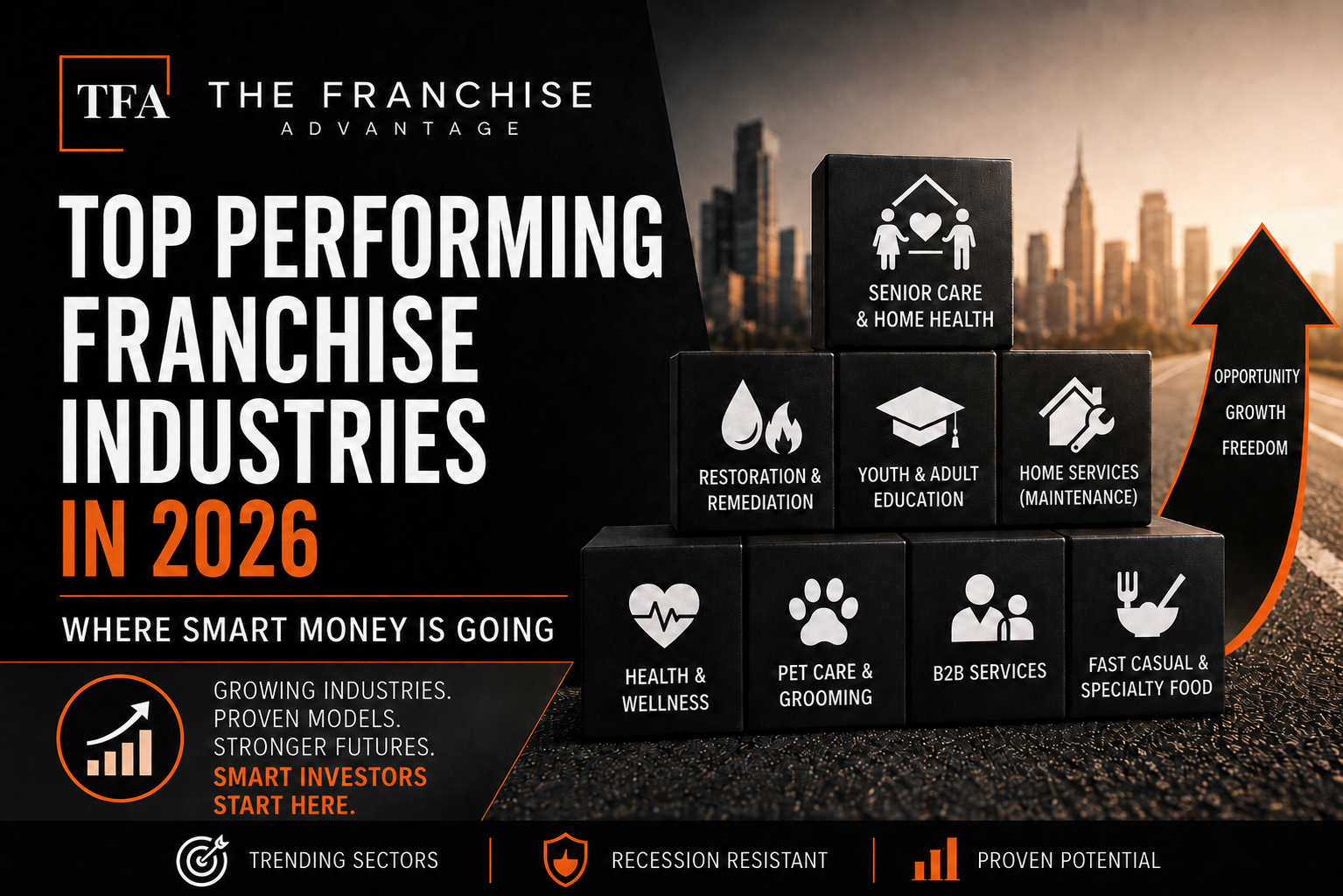
Top Performing Franchise Industries in 2026: Where Smart Money Is Going
Every year, thousands of people enter franchising — and the most successful ones share a common trait: they didn't just buy a franchise they liked. They bought into an industry that the market was already rewarding.
In 2026, the franchise landscape is being shaped by forces that were set in motion years ago and are now fully hitting their stride: a rapidly aging population, a post-pandemic recalibration of how people spend money on health and home, a resurgent small business economy, and a consumer culture that increasingly values convenience, care, and experience over products.
If you're considering franchise ownership this year, understanding where the real momentum is — and why — will give you a significant advantage in choosing the right category and the right brand.
This is where smart investors are looking in 2026.
2026 Franchise Industry Outlook at a Glance
Before we go deep on each sector, here's a high-level snapshot of the industries generating the most interest and investment activity among franchise buyers in 2026:ndustry
Outlook
Senior Care & Home Health (5 Stars) - Aging Boomers driving historic demand for in-home and companion care services.
$30K – $150K
Restoration & Remediation (5 Stars) - Water, fire, and mold damage services. Insurance-backed revenue, recession-proof demand.
$75K – $200K
Youth & Adult Education (4 Stars) - Tutoring, STEM, coding, and trade skills. Parents investing heavily in supplemental education.
$25K – $150K
Home Services (Maintenance) (4 Stars) - Painting, handyman, plumbing, electrical. Low-inventory, high-demand, local model.
$50K – $200K
Health & Wellness - (4 Stars) - Fitness studios, IV therapy, med spas. Consumer spending on personal health remains strong.
$100K – $500K
Pet Care & Grooming (4 Stars) - Mobile grooming, boarding, and training. U.S. pet industry crossed $150B in 2025.
$20K – $200K
B2B Services (3 Stars) - Staffing, marketing, HR, IT support. SMBs outsourcing more functions than ever in 2026.
$50K – $200K
Fast Casual & Specialty Food (3 Stars) - Evolving consumer tastes favoring health-forward, customizable concepts over traditional QSR.
$200K – $600K
Why this list matters for SEO and for your investment:
These aren't arbitrary rankings — they reflect a combination of franchisee satisfaction data, industry growth projections, resale demand, and the categories where franchise brokers are seeing the highest buyer interest in 2026. The best franchise for you may not be the hottest industry overall, but understanding where the market is moving helps you ask better questions and make a more confident decision.
The 5 Hottest Franchise Sectors in 2026 (And Why)
1. Senior Care & Home Health: The Demographic Tidal Wave
If there is one franchise sector that is genuinely impossible to argue against in 2026, it is senior care.
The oldest Baby Boomers — born in 1946 — are now 80 years old. The wave of Americans entering the age range where they need assistance with daily living, companionship, and non-medical home care is not a trend. It is a demographic reality that will continue building for the next 15 to 20 years regardless of economic conditions.
By the numbers:
The U.S. Census Bureau projects that by 2030, all Baby Boomers will be over 65 — representing roughly 73 million Americans. The Bureau of Labor Statistics identifies home health and personal care aide roles as among the fastest-growing occupations in the country. Franchise brands in this space are expanding aggressively in 2026 to meet demand that consistently outpaces supply.
Non-medical senior care franchises — companion care, personal assistance, transportation, and daily living support — tend to sit in the $30,000 to $100,000 investment range and are among the most operationally accessible franchise categories for owners without healthcare backgrounds. What franchisors look for is compassion, organizational ability, and strong people management — not clinical credentials.
For investors thinking about recession resistance: senior care demand does not slow during economic downturns. People do not delay care for their aging parents because the stock market dips. This is one of the most durable businesses in the entire franchise universe.
2. Restoration & Remediation: The Invisible Recession-Proof Giant
Water damage. Fire damage. Mold remediation. Storm restoration. These are businesses that most people never think about — until they desperately need them. And in 2026, demand for restoration services is at an all-time high.
Several converging forces are driving this. An aging U.S. housing stock means more plumbing failures, roof leaks, and structural issues. Climate-related weather events — flooding, storms, wildfires — are increasing in frequency and severity across multiple regions. And critically: the vast majority of restoration work is paid for by insurance, not out of pocket, making it genuinely recession-proof.
When a homeowner's basement floods, they don't shop for the lowest price and they don't wait for the economy to improve. They call immediately and file a claim. Franchise owners in this space have recurring, insurance-backed revenue streams that are extraordinarily stable.
2026 growth note:
Restoration franchise brands have seen significant expansion in territory availability in 2026 as aging franchise owners in this sector retire, creating opening opportunities in markets that were previously closed. Buyers with strong organizational skills and the ability to manage crews and vendor relationships tend to excel in this category.
Investment ranges for restoration franchises vary widely based on equipment requirements. Mobile and lighter-touch models can start under $100,000. Full-service restoration operations requiring heavy equipment may run $150,000 to $300,000 or more. The upside, however — including commercial contracts, insurance relationships, and strong resale multiples — makes this one of the most compelling investment categories in 2026.
3. Youth & Adult Education: Skills Are the New Currency
The education franchise category is experiencing a genuine renaissance in 2026 — and it goes well beyond traditional after-school tutoring.
Post-pandemic learning gaps continue to drive demand for supplemental academic support. But the bigger story is what's happening with adult and workforce education. Trade skills, technology literacy, coding, financial literacy, and AI fluency are now understood by most working Americans to be career-critical — and many are actively seeking structured, in-person learning environments to acquire them.
Franchise brands in the education sector now span:
• K-12 academic tutoring and test prep (perennial demand, stable recurring revenue)
• STEM and coding programs for children and teenagers
• Trade skills training programs capitalizing on the skilled labor shortage
• Adult professional development and upskilling franchises
• Early childhood education and learning centers
Investment levels in education franchises vary widely by format. Home-based or studio-based tutoring concepts can start under $50,000. Learning center franchises with dedicated space typically range from $100,000 to $250,000. For buyers who value meaningful work alongside strong business fundamentals, this is one of the most personally rewarding sectors in franchising.
4. Home Services & Maintenance: The Permanent Boom
Residential home services have been on an extraordinary growth trajectory for several years — and 2026 shows no sign of that momentum slowing.
A combination of factors is sustaining demand at historic levels: an aging housing stock requiring more maintenance, homeowners who accumulated significant equity during recent years and are investing it in improvements, a general shortage of skilled independent tradespeople, and a consumer culture that increasingly values the convenience of booking a vetted, insured professional over DIY.
The franchise model is particularly well-suited to home services because it solves the trust problem. Consumers know the name. They know someone else has vetted the operator. They book with confidence. For franchise owners, this brand recognition translates directly into faster customer acquisition and stronger word-of-mouth.
Top home service categories generating strong franchisee results in 2026 include:
• Interior and exterior painting
• Handyman and general maintenance services
• Window cleaning and pressure washing
• Epoxy flooring and garage renovation
• Holiday lighting installation (highly seasonal but extraordinarily profitable)
• Fence, deck, and outdoor renovation services
Most home service franchises in these categories fall in the $50,000 to $200,000 total investment range, require no storefront, and can be operated with a small crew. For buyers who are strong at operations, customer relationships, and team management, home services offer excellent unit economics and strong resale demand.
5. Health & Wellness: Where Consumer Spending Is Holding Strong
Consumer spending on personal health and wellness has proven remarkably resilient — even as discretionary spending in other categories contracts. In 2026, Americans are prioritizing their physical and mental wellbeing in ways that are generating sustained demand across multiple franchise categories.
Market context:
The global wellness industry exceeded $6 trillion in 2025 according to the Global Wellness Institute — driven heavily by fitness, nutrition, mental health services, and personal care. Franchise brands in this space are capturing a growing share of a market that has become mainstream, not niche.
The health and wellness franchise category is broad in 2026 and getting broader. Buyers can choose from:
• Boutique fitness studios (pilates, yoga, cycling, strength training)
• IV therapy and wellness infusion clinics — one of the fastest-growing new franchise categories
• Medical weight loss and metabolic health clinics (accelerated by GLP-1 medication awareness)
• Mental health and counseling practice franchises
• Float therapy and recovery-focused wellness studios
• Nutrition counseling and functional medicine support franchises
Investment ranges vary considerably — boutique studios typically run $150,000 to $350,000, while medically-oriented concepts may require $300,000 to $600,000 or more depending on buildout and equipment. The key is matching the business model to your background, your risk tolerance, and your market demographics.
What Makes a Franchise "Recession-Proof" in 2026?
With economic uncertainty continuing to be part of the conversation in 2026, many franchise buyers are specifically asking about recession-resistant categories. Here's how to think about it:
A truly recession-resistant franchise operates in a category where demand is driven by need rather than want. People may cut back on luxury goods during a downturn — but they don't stop caring for aging parents, repairing water-damaged homes, educating their children, or maintaining their physical health.
The clearest markers of a recession-resistant franchise in 2026:
• Services with insurance-backed revenue (restoration, senior care) — payment doesn't depend on discretionary consumer budgets
• Essential services with recurring demand (home maintenance, cleaning, lawn care) — people delay but rarely eliminate
• B2B services sold to businesses that need to operate regardless of economic conditions (staffing, commercial cleaning, bookkeeping)
• Child-related services — parents maintain spending on their children's education and development even during downturns
• Health services tied to non-elective medical need — senior care, physical therapy support, mental health services
By contrast, franchises that depend heavily on discretionary consumer spending — luxury retail, entertainment, high-end dining — tend to show more volatility during economic contractions, though well-run operations in strong markets can weather downturns.
Industries That Are Showing Caution Signs in 2026
Smart investors don't just ask where to look — they ask where to be careful. A few categories deserve additional scrutiny in 2026:
Traditional fast food / QSR
The quick-service restaurant category remains one of the largest in franchising by unit count, but it faces real headwinds in 2026: rising food and labor costs, changing consumer preferences toward healthier options, and significant corporate-level pressure on franchisees around remodel requirements and menu changes. This doesn't mean QSR franchises can't be successful — many are — but buyers should do extensive Item 19 analysis and franchisee validation before committing in this space.
Retail concepts without a strong e-commerce integration
Brick-and-mortar retail franchises that haven't built a compelling omnichannel strategy are facing structural challenges that even good operators struggle to overcome. Exceptions exist — particularly in specialty retail, experiential retail, and categories where in-person service is inherently necessary — but pure product-retail concepts warrant extra scrutiny.
Fitness concepts in oversaturated markets
The boutique fitness space is strong overall, but certain market areas have become highly competitive, with multiple studios vying for a finite pool of customers. Territory research is critical before committing to a fitness franchise — what works in a suburban market with limited competition may be a different story in a dense urban environment already saturated with concepts.
The takeaway:
No industry is universally good or bad — what matters is matching the right category to your market, your skills, and your goals. This is exactly why working with an experienced franchise broker is so valuable: they know which brands within each category are outperforming, which territories are available, and which opportunities have the unit economics to support your financial goals.
How to Choose the Right Industry for You in 2026
Industry trends matter — but they're only one input in a well-rounded franchise selection process. The hottest category in the country won't serve you well if the business model doesn't fit your lifestyle, your skills, or your market.
Here's the framework we use with our clients:
• Match industry growth to personal fit: Senior care may be the fastest-growing sector in the country, but if you're not energized by service-oriented work, you'll struggle to build the team culture that makes these businesses successful.
• Evaluate your local market: National trends don't always play out uniformly at the local level. A category booming in the Sun Belt may be saturated in your market — or an underserved opportunity may exist in a category that looks quieter on a national scale.
• Understand the ownership model: Do you want to be actively managing a team, or do you want a more executive, semi-absentee role? Different industries support different ownership structures. Restoration and home services often require high owner engagement early on; B2B and education concepts can sometimes be more manager-run.
• Stress-test the unit economics: Review Item 19 of the FDD for financial performance data. Understand the typical revenue ramp, average unit volume, and franchisee break-even timeline for any category you're seriously considering.
• Talk to franchisees in your target industry: No amount of trend research substitutes for 10 conversations with people who are actually running the business today. Ask them what's changed in the last 12 months, what the market looks like in 2026, and what they'd do differently.
Frequently Asked Questions
Q: What is the fastest-growing franchise industry in 2026?
Senior care and home health is widely considered the fastest-growing franchise sector in 2026, driven by the accelerating aging of the Baby Boomer generation. Restoration and remediation services are also seeing exceptional demand, fueled by aging housing infrastructure and weather-related damage events. Health and wellness — particularly IV therapy and medical weight loss — is the fastest-growing new category in terms of brand launches and buyer interest.
Q: What are the most recession-proof franchises in 2026?
Recession-proof franchises tend to be those serving essential needs with non-discretionary demand. In 2026, the strongest categories for recession resistance include senior care (insurance-backed, demographically driven), restoration services (insurance-backed, emergency-driven), home maintenance (people defer but rarely eliminate), B2B services, and children's education. These categories have demonstrated demand stability across multiple economic cycles.
Q: Is it a good time to buy a franchise in 2026?
For well-capitalized buyers who have done thorough due diligence, 2026 presents meaningful franchise opportunities — particularly in service-based categories where demand is outpacing the supply of qualified operators. Economic uncertainty has actually created opportunities: some franchisors are offering more favorable territory terms, and franchise resale opportunities have increased as older owners seek exits. The fundamentals of evaluating any franchise haven't changed: validate the unit economics, speak to franchisees, and work with an experienced broker.
Q: Which franchise industries are best for first-time buyers in 2026?
First-time buyers in 2026 tend to find the most success in categories with strong franchisor support systems, manageable staffing requirements, and lower investment thresholds. Home services, cleaning and janitorial, education, and B2B service franchises consistently score well on these criteria. Senior care is also excellent for first-time buyers in terms of support and demand, though it requires genuine commitment to the mission of caring for others.
Q: How do I find out which franchise industries are available in my market?
Territory availability varies significantly by brand and region. The best way to identify what's open in your specific market — and which brands are actively recruiting in 2026 — is to work with us at The Franchise Advantage where we have current relationships with franchisors across multiple industries. A broker can tell you not just what's theoretically available, but what's actually a good opportunity given your local demographics, competition, and growth trajectory.
Want to Know Which 2026 Franchise Trends Apply to Your Market?
Industry trends tell you where the market is moving. A franchise broker tells you where the opportunities are — specifically in your city, at your investment level, for someone with your background.
As a franchise broker, we stay current on what's opening, what's performing, and what smart investors are buying in 2026 across every major industry sector. We bring that knowledge to every client conversation — and we do it at no cost to you.
In a free 30-minute consultation, we can help you:
• Identify which 2026 franchise trends are most relevant to your goals and market
• See a curated shortlist of brands in the sectors that match your profile — with territories available now
• Understand the real unit economics behind the fastest-growing franchise categories
• Ask every question you have about a specific industry or brand — with honest, unbiased answers
Schedule Your Free Franchise Consultation Today
No cost, no pressure, no obligation. Just expert guidance on where the best franchise opportunities are in 2026 — and how to find the one that's right for you.
7/22/2026 | Tags: Top Performing Franchise Industries